Languages

Topbar Menu EN

The SDG Fund is operationally closed. This site is alive for knowledge and dissemination purposes.
Warning: This website is closed. Be aware of phishing or social engineering fraudulent requests of payments or certificates. Explore our programme areas.
Please visit jointsdgfund.org
Search our database of publications


Ensuring escapes from poverty are sustained in rural Bangladesh
Bangladesh has experienced substantial reductions in both extreme poverty and poverty. The proportion of the population living below the national extreme poverty line has reduced from 50 percent in 1991 to 18 percent in 2010 while the poverty headcount ratio, using the national poverty line, has reduced from 60 percent to 32 percent over the same period. Economic growth, increased non-farm employment (particularly in the ready-made garment industry), international migration, and investments to improve human development outcomes have all contributed strongly to this success. However, some households escape poverty only to live at a level just above the poverty line: 19 percent of the population lives out of poverty, but has a level of consumption less than 1.25 times the national poverty line. They therefore remain vulnerable to slipping into poverty in the event of a shock or stressor, such as an episode of ill-health or a flood. This report combines analysis from three rounds of the Chronic Poverty and Long-Term Impact Study with qualitative research approaches; in particular: key informant interviews, life histories, and participatory wealth ranking to further investigate the drivers of transitory poverty escapes or of re-impoverishment. Specifically, it examines why some households are able to escape poverty and remain out of it—that is, they experience sustained escapes from poverty—while others escape poverty only to return to living in it again. The report investigates the resources (land, livestock, and value of assets), attributes (household composition and education level), and activities (including jobs and engagement in non-farm activities) of households that enable them to escape poverty sustainably and minimize the likelihood of returning to living in poverty again.

View online/download
External Link

Improving WASH service delivery in protracted crises: the case of the Democratic Republic of Congo

This report examines the structural barriers that exist between humanitarian and development forms of water supply, sanitation and hygiene (WASH), and identifies how they can be overcome for more effective and sustainable services in the Democratic Republic of Congo (DRC). We highlight barriers at three levels: the normative level, expressed in the humanitarian and development communities’ respective mission statements, principles and standards; the level of incentives, which are expressed in the signals given by funding and accountability arrangements as well as ingrained attitudes to risk; and the level of operational processes for targeting, implementation, staff recruitment and development, and dialogue. We recommend action to develop mutually agreeable ways of working to provide guidance at the country level and below to tackle the incentive structures created by funding, reporting and risk management structures, and to increase dialogue between humanitarian and development communities within and beyond the WASH sector.

View online/download
External Link

Improving WASH service delivery in protracted crises: the case of South Sudan

This report examines the structural barriers that exist between humanitarian and development forms of water supply, sanitation and hygiene (WASH), and identifies how they can be overcome for more effective and sustainable services in South Sudan. We highlight barriers at three levels: the normative level, expressed in the humanitarian and development communities’ respective mission statements, principles and standards; the level of incentives, which are expressed in the signals given by funding and accountability arrangements as well as ingrained attitudes to risk; and the level of operational processes for targeting, implementation, staff recruitment and development, and dialogue. We recommend action to develop mutually agreeable ways of working to provide guidance at the country level and below to tackle the incentive structures created by funding, reporting and risk management structures, and to increase dialogue between humanitarian and development communities within and beyond the WASH sector.

View online/download
External Link

Africa’s new climate economy: economic transformation and social and environmental change

Africa’s 'growth miracle' in the 21st century has reversed a long-standing narrative of pessimism about the region. GDP growth reached around 5% annually from 2001-2014. Rates of extreme poverty fell substantially. Yet big challenges remain. Growth slumped in 2015 and 2016. The region lags far behind on most measures of human development. Climate change is also taking an increasing toll on many countries: the region is warming faster than the world as a whole, and many areas will experience more frequent and intense droughts and floods. The economic impacts of climate change are expected to be severe, with agriculture and poor people especially at risk. This report lays out five key action areas for economic transformation and social and environmental progress in Africa: 1) getting the fundamentals right; 2) transforming agriculture and land use; 3) diversifying into manufacturing and other high-productivity sectors; 4) unleashing the power of urbanisation; and 5) fostering a modern energy transition.

View online/download
External Link

Understanding the context of the Youth Forward initiative in Ghana

Youth Forward focuses on economically disadvantaged young people, aged 15-24, living in Ghana and Uganda who are on a low income (living on less than $2 a day), out of school, unemployed or underemployed, and moving through a transition point in their life. Ghana has achieved significant economic growth and development since its transition to multi-party democracy and the political stability that has accompanied this. However, young people have not always benefited from growth as much as other groups. For young people to benefit from economic opportunities, it is necessary to engage a diverse range of actors, including state-run marketing boards and traditional leaders. One of the most important questions is access to land, which will allow both for profitable cocoa farming and spur demand for construction services benefiting young artisans. The context in which a programme operates can influence implementation efforts and outcomes. Using an Overseas Development Institute political economy analysis framework, this paper explores the context of the Youth Forward initiative in Ghana. It first establishes the underlying cultural, political, economic and geographical factors, which influence the country today, and then identifies key stakeholder groups with influence on the initiative’s progress, to locate entry points for Youth Forward to influence and shape local dynamics.

View online/download
External Link

Women's economic empowerment: navigating enablers and constraints

New analysis of Gallup World Poll data reveals that in 17 countries across sub-Saharan Africa, the Middle East and North Africa surveyed in 2009, on average, about 90% of women and men reported that having a good quality job is ‘essential’ or ‘very important’ to them – yet only one in seven women (14%) in these countries was engaged in formal full-time employment compared with one in three men (33%). This report details how gender equality, poverty eradication and human development require increased investment in women’s economic empowerment. The report also brings together new and existing evidence to propose a set of core building blocks for the complex process of women's economic empowerment. No single intervention or actor can address all of its aspects, but we identify 10 key factors that can enable or constrain women’s economic empowerment, and make recommendations for policy and practice for each:

View online/download
External Link

The impact of the UK's post-Brexit trade policy on development

Following the vote for Brexit, the UK is facing a formidable challenge: designing a new trade policy to address its new strategic interests. Considering the different and frequently opposing interests, this task is far from straightforward. Given the magnitude of the tasks and the number of negotiations that the UK will face in the next few years, there is a major risk that developing countries will be overlooked. This collection of essays offers a number of perspectives on how a new UK trade policy towards developing countries and regions could be designed and implemented, in both the short and longer term. It also conveys the concerns, opportunities and expectations from a group of leading trade specialists from academia, international organisations and think tanks in the UK and elsewhere.

View online/download
External Link

Ensuring escapes from poverty are sustained in rural Ethiopia

This report examines why some households in Ethiopia are able to escape poverty and remain out of it—that is, they experience sustained escapes from poverty—while others escape poverty only to return to living in it again – that is, they experience transitory escapes. With this term, the report refers to households that successfully escape from poverty only to return to living in it once again, i.e. they become re-impoverished. The report investigates the resources (land, livestock, and value of assets), attributes (household composition and education level), and activities (including jobs, engagement in non-farm activities and migration) of households that enable them to escape poverty sustainably and minimize the likelihood of returning to living in poverty again.

View online/download
External Link

Sustainable cities: internal migration, jobs and the 2030 Agenda for Sustainable Development

This briefing presents an overview of how rural to urban migration (internal migration) impacts on the achievement of the Sustainable Development Goals (SDGs), in particular Goals 8 and 11. Despite the positive impact that internal migration can have on urban migrants, their families, and their 'host' city, urban migrants are often neglected in government policies. This briefing therefore presents a number of policy recommendations which aim to capture this potential and contribute to achieving the 2030 Agenda on Sustainable Development.

View online/download
External Link

Climate finance briefing: Small Island Developing States (SIDS)

The 39 Small Island Developing States (SIDS) together bear little responsibility for climate change: in 2012, all the SIDS combined accounted for just 1% of global carbon dioxide emissions. Despite this, the SIDS’ geographical, socio-economic and climate profiles make them particularly vulnerable to the impacts of climate change. For example, Tuvalu and the Maldives do not reach higher than 5 metres above sea level, making them highly susceptible to flooding. This briefing explores the amount of climate finance the SIDS have been granted thus far, and to what extent this support meets the SIDS’ needs.

View online/download
External Link

Unexpected allies: fossil fuel subsidy reform and education finance

Despite the urgency of transitioning to low-carbon societies, global fossil fuel subsidies are still significant – estimated at $646 billion in 2015. At the same time, governments have made high-level commitments to increase public spending on working towards the Sustainable Development Goals (SDGs), including that on education. The government spending gap to reach universal, good quality education in low and lower-middle income countries by 2030 is estimated at $39 billion a year between 2015 and 2030. Although the need for subsidy reform and elements of its processes have received extensive attention from the research community, the specific procedures for mitigating the adverse impacts of reform and using the fiscal space created through subsidy phase-out have received less attention. This is particularly important, as removing fossil fuel subsidies is likely to have a negative impact on the purchasing power of low-income households if parallel measures to protect the poorest are not undertaken. These measures include increased public spending on social protection, education and health. However, few studies have reviewed whether the promises made in the reform process, including those related to education, have been met, and if so, how. This report therefore evaluates the links between fossil fuel subsidy reforms and promised increases in expenditure on education, in particular in Angola, Ghana, Egypt, Indonesia, Morocco, Niger, Peru and the Philippines. Further, it provides two case studies of experiences that Ghana and Indonesia have had with linking subsidy reforms to increasing expenditure on education and other measures that have had indirect benefits for education, such as (conditional) cash transfers.

View online/download
External Link

Finding the pipeline: project preparation for sustainable development

Delivering the Sustainable Development Goals (SDGs) and achieving the Paris Agreement objectives will require increased investment in socially, economically and environmentally sustainable infrastructure. The main barrier to investment of the kind needed is not the lack of available finance, but rather a lack of well-prepared and investment-ready 'bankable' projects. Whether or not a project is bankable – i.e., attractive enough for investors to decide to invest – depends on a number of factors including the policy and regulatory environment, consultations with relevant stakeholders, capacity to engage with investors and manage transactions, quality of project documentation, and economic development issues such as creditworthiness and willingness to pay. The international community has launched numerous capacity building and technical assistance initiatives to address these factors, but greater effort will be needed to mobilise public and private investment in developing and emerging economies for sustainable infrastructure. This report considers the complexities that underpin efforts to attract investment into sustainable infrastructure with a focus on project preparation. It reflects on experiences with project preparation support for infrastructure and potential shifts in approach needed to deliver the scale of investment required in sustainable infrastructure to achieve the SDGs and fulfil the goals of the Paris Agreement.

View online/download
External Link

Sanitation under stress: how can urban services respond to acute migration?

This working paper aims to identify key research questions around the successes and failures of urban governance structures in delivering essential services to populations following large migration movements. It does so through a review of the existing literature on the subject. It then unpacks how conflict-induced migration has affected Jordan’s urban infrastructure and systems for the provision of basic services. In conclusion, we call for a research agenda that can help utilities, governments, non-governmental organisations and other service providers to better understand and overcome the challenges of sanitation provision in urban contexts ‘under stress’, without reinforcing existing inequalities or creating new ones, and to progress towards realising the Sustainable Development Goals’ aspirations for ‘universal access to adequate and equitable sanitation’ by 2030.

View online/download
External Link

Enhancing multilateral loans for education: intervention rationales, mechanisms, options and decision criteria

This report considers whether, given the large financing gap facing many countries in education, it is possible for leveraging and blending of grants and loans, particularly through the multilateral banks, to play an expanded, catalytic role. The report also asks how such interventions can best be designed so as to help crowd in domestic and private finance along with international grants and loans.

View online/download
External Link

Financing education: domestic resource mobilisation and allocation

Despite considerable efforts by governments, civil society and the international community, the world is still far from its goal of providing a quality education for all. This is partly due to challenges in mobilising the necessary financial resources and ensuring their effective use. The aim of this report is to identify opportunities for improving the allocation of spending towards priority sectors like education by examining spending patterns and allocation mechanisms. First, it identifies key patterns and trends of public education spending by income, by region and by level of education since the mid/late 1990s. Second, it uses correlation analysis and multivariate regressions to explore the drivers and correlates of government expenditure on education. Third, it assesses mechanisms that could potentially enable governments to alter the composition of their expenditure in favour of education (and other priority sectors generally).

View online/download
External Link

Water management and stewardship: taking stock of corporate water behaviour

Commercial companies have become increasingly active in debates regarding water management. Company representatives arrive in numbers at the annual World Water Week in Stockholm and are increasingly active in sessions there, as well as appearing on panels at other water-related international conferences and meetings. The World Water Council and the OECD note that ‘companies have been outspoken’ in their ‘warnings of water risks to their operations’, which, if not managed, will ‘pose a threat to economic growth’. The discussion paper considers the opportunities for stewardship to strengthen water management and achieve development benefits, and discusses the issues to which water stewardship gives rise including identifying expectations that are misplaced and cautioning against misleading claims. The drivers of corporate ‘water behaviour(s)’ are discussed and progress towards water ‘stewardship’ against the international guides/standard assessed.

View online/download
External Link

How can social protection build resilience? Insights from Ethiopia, Kenya and Uganda

This paper presents a synthesis of findings from Ethiopia, Kenya and Uganda on the role of social protection programmes in contributing to people’s capacity to absorb, anticipate and adapt to climate-related shocks and stresses. The paper reflects on the actual and potential contributions social protection can make to increase the resilience of the poorest and most vulnerable. The analysis is informed by an understanding that resilience to climate extremes and disasters cannot be built by one programme or sector alone, but requires a range of programmes that together increase the capacity of people and governments to reduce the diverse set of risks that underpin poverty and vulnerability and increase the risk of disasters. For this, the competitive advantage of different sectors needs to be identified and strengthened to form part of a wider cross-sectoral sustainable development agenda.

View online/download
External Link

‘Turning a blind eye’: the policy response to Rohingya refugees in Malaysia

At the end of October 2016, there were 150,669 refugees and asylum-seekers registered with the United Nations High Commissioner for Refugees (UNHCR) in Malaysia; 54,856 of whom were Rohingya. Estimates suggest tens of thousands more Rohingya refugees remain unregistered in Malaysia. This working paper considers the institutions, organisations and policies that affect the lives and livelihoods of Rohingya refugees in Malaysia. It begins by describing the stakeholders involved with refugees in Malaysia: their roles, constraints, interactions and key policies (such as registration) as they pertain to Rohingya refugees. Subsequent themes explored in the working paper include refugees and employment – such as potential advantages and concerns regarding the introduction of work permits for refugees – and interactions between refugee community-based organisations, aid actors and Malaysians.

View online/download
External Link

Child labour and education: a survey of slum settlements in Dhaka

Urbanisation has powered Bangladesh’s development. But it has gone hand-in-hand with the rapid growth of urban slums marked by high levels of poverty and low levels of service provision. In these slums, child labour is rife. This publication presents findings from one of the largest surveys on child work and education conducted in Bangladesh. ODI research found that 15% of 6 to 14-year-old children in Dhaka's slums were out of school and engaged in full-time work. Average working hours for these children were well beyond the 42-hour limit set by national legislation. The garments sector accounted for two thirds of female working children, raising serious concerns over garment exports and child labour. By the age of 14, almost half of children living in the slums of Dhaka were working. The research shows how early exposure to work and withdrawal from education are harmful to children. This report offers recommendations for coordinated, cross-sectoral policies to break the link between child labour, social disadvantage and restricted opportunities for education. Policies must be integrated to span the regulation of labour markets, education, child welfare and wider global strategies for poverty reduction – what we found in Dhaka is a microcosm of a global problem that should be at the centre of the international agenda.

View online/download
External Link

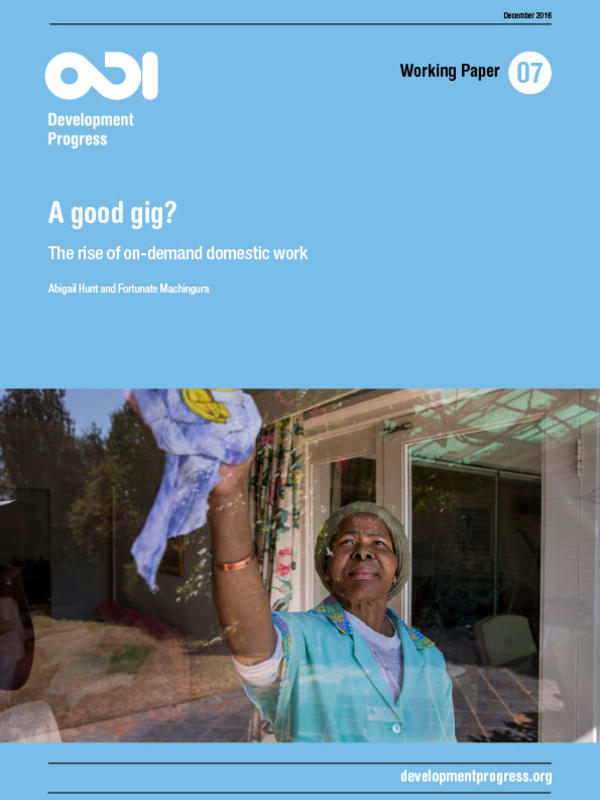
A good gig? The rise of on-demand domestic work

Women make up 80% of the 67 million domestic workers globally, increasing numbers of whom are now turning to the rapidly-growing on-demand economy for domestic work in developing countries. The potential risks and benefits attached to this burgeoning form of work may therefore affect women disproportionately. On-demand work is not automatically empowering, and can shift risk from employers onto domestic workers themselves. This report proposes that urgent action be taken to ensure that the 'Uberisation' of domestic work evolves to the benefit of all. The infancy of the on-demand domestic work economy in developing countries means it is not too late to raise standards. This will involve proactive efforts by companies to 'design-in' good practice, as well as by government to ensure an integrated future policy, legal, practice and research agenda.

View online/download
External Link

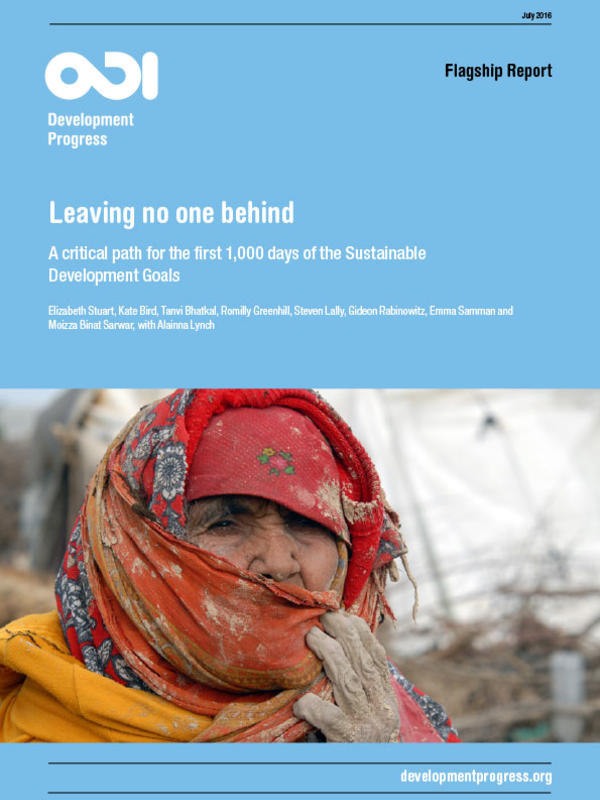
Leaving no one behind: a critical path for the first 1,000 days of the Sustainable Development Goals

Leaving no one behind is the moral issue of our age, and is at the heart of an ambitious blueprint for action: the Sustainable Development Goals (SDGs). One specific goal is ‘ending poverty, in all its forms, everywhere’, but the SDGs also aim to tackle marginalisation. The SDG outcome document specifies that the goals should be met for all segments of society, with an aim to reach those furthest behind first. Now the focus is on implementation, particularly at the national level. This report not only makes the case for early action, it also quantifies its benefits. The report outlines the actions that governments can take in the first 1,000 days of the SDGs to respond to what poor people want and to deliver for the most marginalised people and groups. The evidence shows that achieving the SDGs and the ambition to leave no one behind will become far more difficult the longer governments delay.

View online/download
External Link

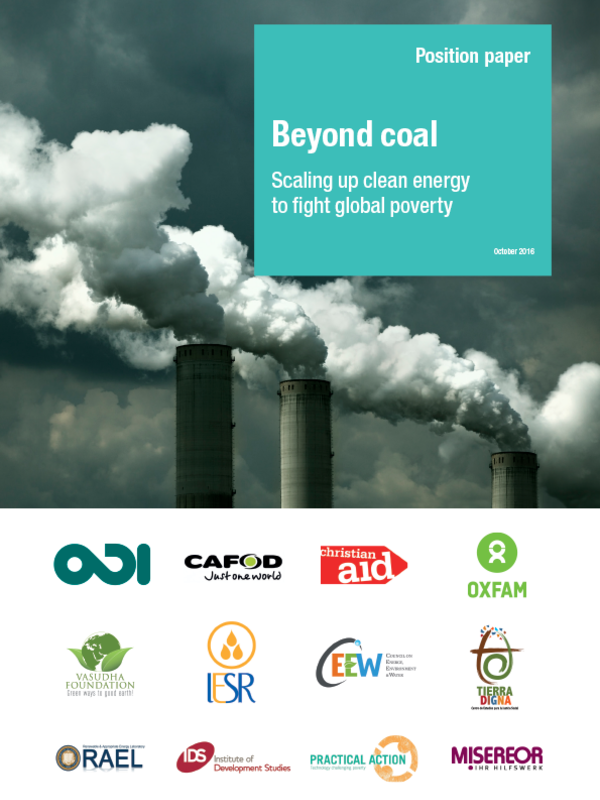
Beyond coal: scaling up clean energy to fight global poverty

Eradicating global poverty is within reach, but under threat from a changing climate. Left unchecked, climate change will put at risk our ability to lift people out of extreme poverty permanently by 2030, the first target of the Sustainable Development Goals (SDGs). Coal is the world’s number one source of CO2 emissions. Most historic emissions came from the coal industry in the developed world in the last century, with China joining the biggest emitters at the beginning of this one. It is widely accepted that a rapid and just response to climate change will require the urgent replacement of coal with low-carbon energy sources in rich economies. Now the coal industry claims that expanding coal use is critical to fighting extreme poverty and improving energy access for billions of people in developing countries. In fact, the opposite is true. The global commitment to eradicate extreme poverty and energy poverty by 2030 does not require such an expansion and it is incompatible with stabilising the earth’s climate. The evidence is clear: a lasting solution to poverty requires the world’s wealthiest economies to renounce coal, and we can and must end extreme poverty without the precipitous expansion of new coal power in developing ones.

View online/download
External Link

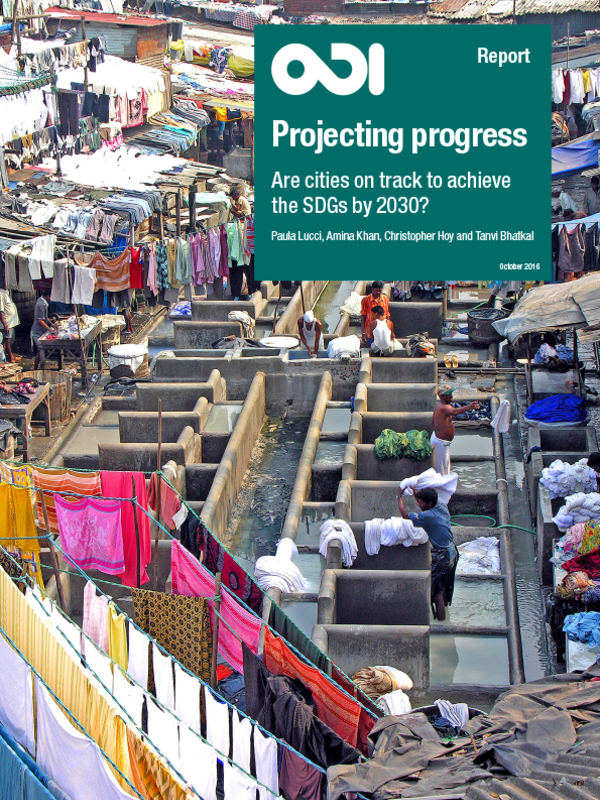
Projecting progress: are cities on track to achieve the SDGs by 2030?

This report explores for the first time the scale of the challenge for 20 cities across the world to reach selected targets set out in the Sustainable Development Goals (SDGs). More than half of the targets included will require a profound acceleration of efforts if they are to be achieved by the majority of selected cities. Targets that are not on course to be met by the majority of cities studied include ending child malnutrition, achieving full and productive female employment, access to adequate housing and access to drinking water and sanitation. The report makes a series of recommendations to increase progress towards the SDGs, including: 1) Central governments and donors should work to strengthen local governments’ capacities; 2) Government and city administrations should invest more in ways to monitor progress on the SDGs; 3) Statistical offices’ and cities’ information systems should improve the data available.

View online/download
External Link

Development finance for water resources: trends in the Middle East and North Africa

This paper provides an overview of development finance for water resources in the Middle East and North Africa (MENA). Based on analysis of reported data and interviews with donor institutions, it explores: how finance for water resources in MENA compares to that in other regions of Africa and Asia; how countries within MENA compare in their access to finance; and how donors from the region and beyond make allocation choices. Based on our findings, we make four key policy recommendations to improve the effectiveness of finance for water resources in MENA: 1. Maintain support for water resources to sustain development gains; 2. Raise the political profile of water resources reform; 3. Use politically aware and cross-departmental approaches; 4. Form innovative donor partnerships in the region.

View online/download
External Link

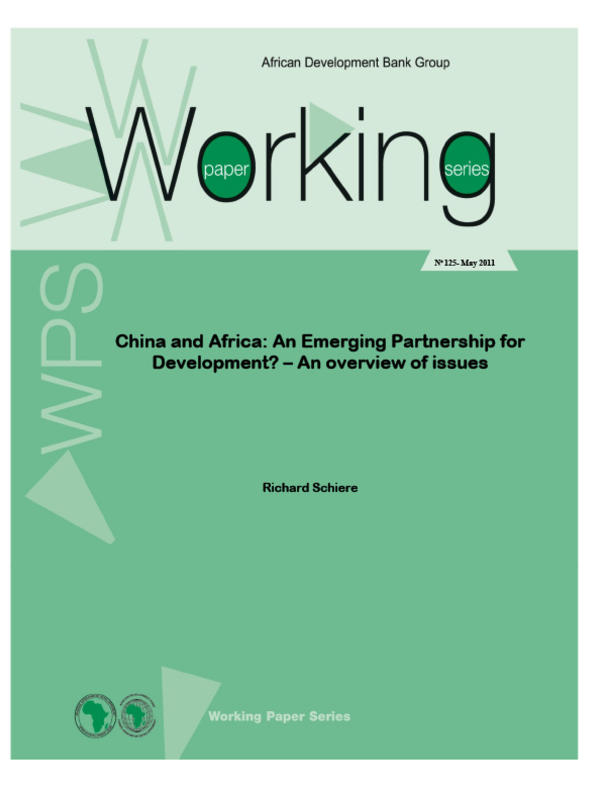
China and Africa: an emerging partnership for development? - an overview of issues

China’s phenomenal growth offers an opportunity to boost development in African countries. Moreover, China’s loans and concessional assistance financed a wide range of development projects. China also is reaping significant benefits from this relationship, through access to raw materials, expanded markets for exports of manufactures, the establishment of investment relationships which could generate significant profits over time and diplomatic influence. But leadership from African governments, particularly to strengthen domestic policies and governance and to harmonize regional policies so as to improve the continent’s bargaining position with China, are required to ensure that the China-Africa relationship contributes to sustainable growth and poverty reduction. The twin goals of this paper are to summarizes the analysis on the economic exchange between China and Africa, and to outline policy recommendations to improve the benefits to both parties.

View online/download
External Link


Suggest a publication

Feel free to submit a publication.

Submit here