Languages

Topbar Menu EN

The SDG Fund is operationally closed. This site is alive for knowledge and dissemination purposes.
Warning: This website is closed. Be aware of phishing or social engineering fraudulent requests of payments or certificates. Explore our programme areas.
Please visit jointsdgfund.org

Search our database of publications


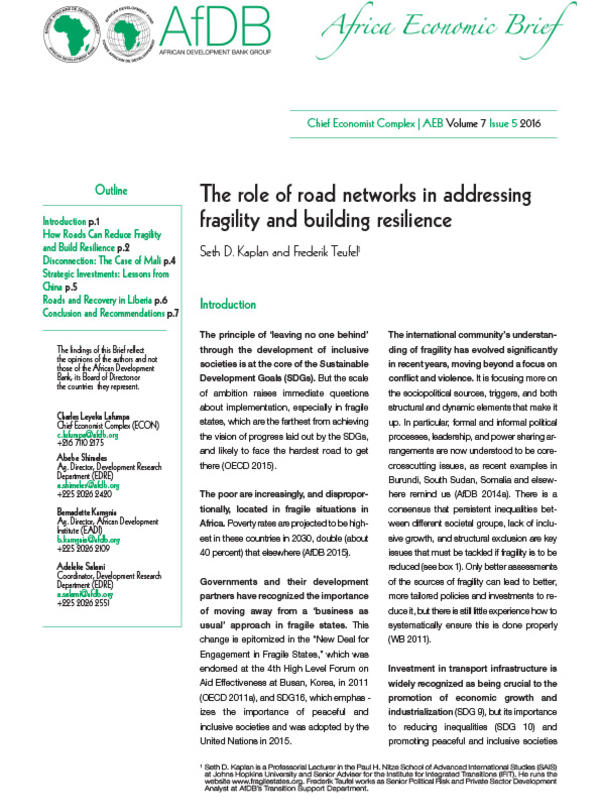
The role of road networks in addressing fragility and building resilience
This brief explores the importance of investments in roads - as the most important component of the transport infrastructure network in fragile states - to political stability, economic inequalities, and institution building, in light of the evolving understanding of fragility. Countries with a recent history of violent conflict face the most daunting challenges, as their (already modest) national infrastructure both suffers from destruction or dilapidation and exacerbates poor economic conditions and the fault lines that caused conflict in the first place (WB 2011). But even investments in stable countries need to be considered strategically to ensure those countries don’t become tomorrow’s fragile states. This brief draws on the examples of Liberia, Mali and China to propose a conceptual framework that can inform government policymakers, regional organizations, and development partners on how to address these challenges.

View online/download
External Link

Transitioning from INDCs to NDCs in Africa

In December 2014, Parties to the United Nations Framework Convention on Climate Change (UNFCCC) meeting in Lima Peru, decided that national contributions to the mitigation challenge and national adaptation actions should be aggregated into Intended Nationally Determined Contributions (INDCs). As a result, 189 countries laid out their approach to tackle mitigation and adaptation by formally presenting their INDCs to the UNFCCC. On 4 November 2016, the Paris Agreement entered into force ahead of the 22nd Conference to the Parties calling for INDCs to be transitioned to Nationally Determined Contributions (NDCs), which will form the foundation of the post-Kyoto multilateral climate regime. Based on literature review and interviews with African stakeholders from the government, civil society and private sector, this study examines national developments and processes related to Paris Agreement ratification in six focus countries—Cameroon, Ethiopia, South Africa, The Gambia, Tunisia and Uganda. More specifically, the study provides a summary overview of the (I)NDCs of all African countries participating in the CIF and examines whether and how African parties are making changes to their INDCs in the process of ratifying the Paris Agreement. Further analysis reveals whether and how countries are planning dedicated policies and measures to implement and achieve INDC mitigation components.

View online/download
External Link

Urban development strategy of the African Development Bank Group

This strategy builds on the achievements and lessons of experience of past African Development Bank Group efforts in urban development and emphasizes the need for coordinated and purposeful action. The Strategy recognizes that successful urban development requires coherent programs and efficient organization both within the Bank Group and in Regional Member Countries. Through this Strategy, the Bank will ensure that key policy themes, particularly infrastructure development, urban governance, private sector development and cross-cutting issues including gender, empowerment of vulnerable groups, regional integration, urban-rural linkages, environment and now increasingly climate change are taken into account during project design and implementation of urban projects. Moreover, the approach will ensure that the Bank’s policy and operational focus ultimately is on the building of viable, accountable and service-centered institutions at the sub-national levels, notably municipalities.

View online/download
External Link

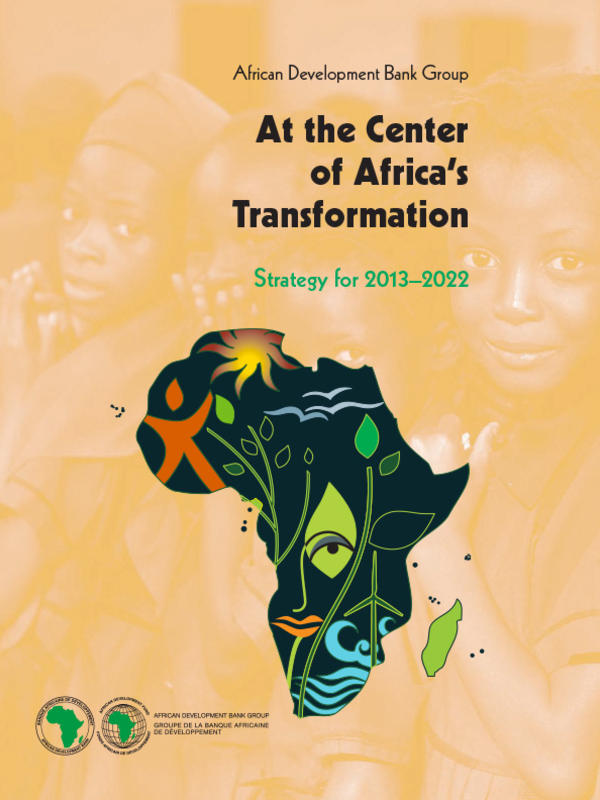
AfDB Strategy for 2013–2022 - at the center of Africa’s transformation

This ten-year Strategy is designed to place the African Development Bank at the centre of Africa’s transformation and to improve the quality of Africa’s growth. The Strategy will focus on two objectives to improve the quality of Africa’s growth: inclusive growth, and the transition to green growth. It also outlines five main channels for the Bank to deliver its work and improve the quality of growth in Africa: Infrastructural development; Regional economic integration; Private sector development; Governance and accountability; Skills and technology. In implementing its ten-year Strategy, and as an integral part of the two objectives, the Bank will pay particular attention to fragile states, agriculture and food security, and gender.

View online/download
External Link

Investing in gender equality for Africa's transformation

It is widely recognised that gender equality is both a development goal in itself and a precondition for the achievement of other development outcomes; it is both a matter of human rights and a matter of development or “smart economics”. Gender equality can enhance economic growth and improve other development outcomes. The African Development Bank Group’s Strategy 2013–2022 recognises the need to reduce gender inequalities by “strengthening women’s legal and property rights, promoting women’s economic empowerment, and enhancing knowledge management and capacity building” on gender equality. These priority areas, defined and agreed in broad consultations with African countries, form the pillars of this strategy document. The focus of this strategy is twofold. First, it seeks to strengthen gender main-streaming in all of the Bank’s country and regional operations and strategies. Second, it addresses the Bank’s own internal transformation to make it a more supportive, gender-responsive institution that values its female and male staff equally, protects them from discrimination and all forms of harassment and violence, and ensures a safe and preferred work environment that attracts the best professionals.

View online/download
External Link

Feed Africa: strategy for agricultural transformation in Africa 2016–2025

There is a massive opportunity to reframe the current social and economic costs associated with the low productivity of the agricultural sector in Africa. What has — up till now — been an area of relative weakness for the African continent, can be recast as an area of strength and, more importantly, one of the fastest options for feeding, employing, and lifting millions of people out of poverty. Agricultural transformation has proven to be a complex endeavour, but is becoming increasingly understood as pockets of successful interventions spring up across the continent. New technologies — especially in the ICT realm — are bringing new ways of achieving and scaling success. Critical to realizing this opportunity will be shifting the development of the sector from ‘agriculture as a way of life’ to ‘agriculture as a business’. The public-sector has an essential role to play in fostering a private-sector led transformation of agriculture. Farmers, entrepreneurs, and investors alike will find a way to develop thriving agribusinesses if given the opportunity in the form of access to sufficient and affordable capital, access to markets and the right overall conditions in terms of policy and infrastructure.

View online/download
External Link

Moving towards a green productive agriculture in Africa: the role of ICTs

Agriculture remains an important source of livelihood for the majority of Africans but the sector is still very unproductive, resulting in food insecurity and large imports of staple foods, putting additional strain on scarce foreign exchange reserves. Acknowledging the rapid uptake of Information and Communication Technologies (ICTs) in Africa and building upon the mitigated success of the green revolution in Asia, the paper discusses the potential of ICTs to transform Africa’s agriculture in an inclusive and sustainable way, by benefiting smallholders, addressing land reform issues, providing adequate financial services, price and market information as well as by boosting global value chains. The study goes further by providing policy recommendations for African governments and the private sector on how ICTs usage could be further leveraged to enhance productivity and promote a green agriculture in Africa.

View online/download
External Link

Impact evaluation in a landscape: protected natural forests, anthropized forested lands and deforestation leakages in Madagascar’s rainforests

This paper analyses deforestation leakages from natural rainforests to anthropized habitats following the creation of Protected Areas in Madagascar. A simple theoretical framework highlights that a conservation constraint does not necessarily create deforestation leakages on secondary forests. An original dataset is built combining fine scale vegetation cover images and spatialized census data over the period 2000 to 2012. Cover images allow us to distinguish a mosaic of landscapes. Multilevel panel regressions and matching techniques indicate a causal effect of Protected Areas on deforestation leakages. Though Protected Areas reduce deforestation in protected natural forests, forest clearing is mostly reported on other types of anthropized forests. Our results demonstrate the limitations of Porter-like mechanism in agricultural innovation. They also support the hypothesis of a conservation dilemma: protecting biodiversity may come at the expense of the welfare of locals who rely on local (provisioning) ecosystem services.

View online/download
External Link

Agricultural production, food security and higher value in North Africa

This paper argues that the problems of food security and rural poverty in North Africa are interlinked. It proposes a strategy to enhance food security while also reducing rural poverty and rural-urban inequality by increasing farmers’ share of value added. The proposed strategy has four prongs: (1) making better use of world markets and maintaining a security food reserve, (2) greater support to domestic food producers (especially small family farmers) to link them better with national and international markets, (3) introducing new social safety net programs based on cash transfers, and (4) building new inclusive economic institutions that represent small farmers and ensure that they have a voice in the policy making process.

View online/download
External Link

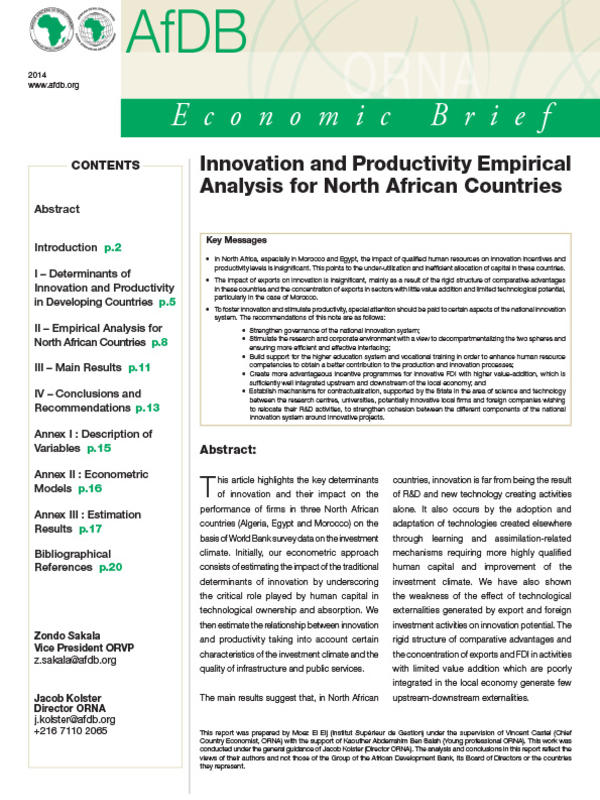
Innovation and productivity: empirical analysis for North African countries

This article highlights the key determinants of innovation and their impact on the performance of firms in three North African countries (Algeria, Egypt and Morocco) on the basis of World Bank survey data on the investment climate. Initially, our econometric approach consists of estimating the impact of the traditional determinants of innovation by underscoring the critical role played by human capital in technological ownership and absorption. We then estimate the relationship between innovation and productivity taking into account certain characteristics of the investment climate and the quality of infrastructure and public services. The main results suggest that, in North African countries, innovation is far from being the result of R&D and new technology creating activities alone. It also occurs by the adoption and adaptation of technologies created elsewhere through learning and assimilation-related mechanisms requiring more highly qualified human capital and improvement of the investment climate. We have also shown the weakness of the effect of technological externalities generated by export and foreign investment activities on innovation potential. The rigid structure of comparative advantages and the concentration of exports and FDI in activities with limited value addition which are poorly integrated in the local economy generate few upstream-downstream externalities.

View online/download
External Link

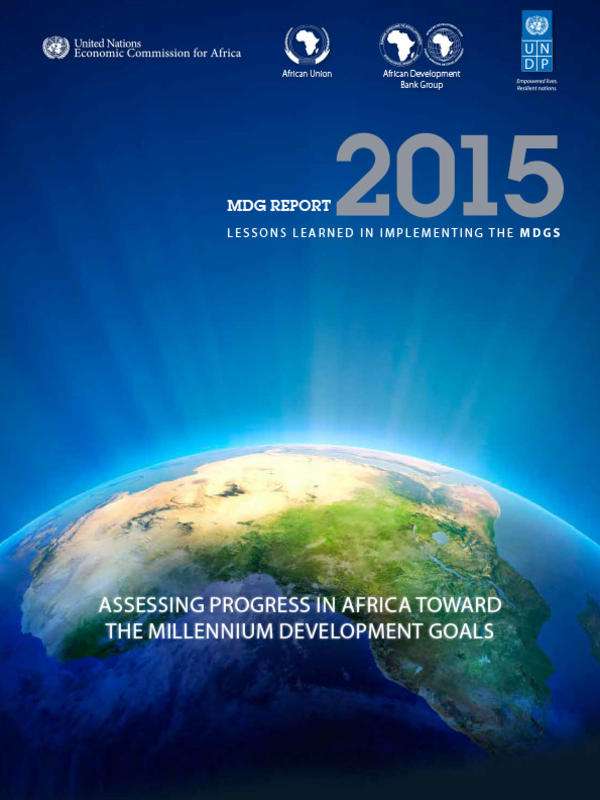
Assessing progress in Africa toward the Millennium Development Goals

This report, produced jointly by the Economic Commission for Africa (ECA), the African Union (AU), the African Development Bank (AfDB) and the United Nations Development Programme (UNDP), assesses the progress towards the Millennium Development Goals (MDGs) in Africa. Africa has seen an acceleration in economic growth, established ambitious social safety nets and designed policies for boosting education and tackling HIV and other diseases. It has also introduced women’s quotas in parliament, leading the way internationally on gender equality, and increased gender parity in primary schools. Although overall poverty rates are still hovering around 48 percent, according to the most recent estimates, most countries have made progress on at least one goal. Much more work lies ahead to ensure living standards improve for all African women and men. While economic growth has been relatively strong, it has not been rapid or inclusive enough to create jobs. Similarly, many countries have managed to achieve access to primary schooling; however, considerable issues of quality and equity need to be addressed.

View online/download
External Link

African human development report 2016

Gender inequality is costing sub-Saharan Africa on average $US95 billion a year, peaking at US$105 billion in 2014– or six percent of the region’s GDP – jeopardising the continent’s efforts for inclusive human development and economic growth, according to the Africa Human Development Report 2016. The report analyses the political, economic and social drivers that hamper African women’s advancement and proposes policies and concrete actions to close the gender gap. These include addressing the contradiction between legal provisions and practice in gender laws; breaking down harmful social norms and transforming discriminatory institutional settings; and securing women’s economic, social and political participation. Deeply-rooted structural obstacles such as unequal distribution of resources, power and wealth, combined with social institutions and norms that sustain inequality are holding African women, and the rest of the continent, back. The report estimates that a 1 percent increase in gender inequality reduces a country’s human development index by 0.75 percent.

View online/download
External Link

A compendium of case studies on gender mainstreaming initiatives in UN-Habitat 2008-2012

Whilst we recognize that much work has been done in the main-streaming of gender equality in human settlement, UN-Habitat acknowledges that much more is required. This compendium of case studies is designed to bring into one document some of the gender main-streaming initiatives UN-Habitat implemented from 2008 to 2012. The case studies provide the most comprehensive examples of the field implementation of the UN-Habitat Gender Equality Action Plan of 2008 to 2013. The projects and programmes compendium brings recognition to UN-Habitat’s efforts to advance the internationally agreed agenda for Gender Equality and Empowerment of Women. The compendium serves as a good start towards capturing the successful efforts under way to advance the agenda on equality and empowerment of women. In addition, the compendium serves as a learning and resource tool to UN-Habitat and its partners

View online/download
External Link

Gender issue guide: gender-responsive urban basic services

This issue guide focuses attention on urban basic services in order to illuminate the effects of gender on equality of access and inclusion in the areas of urban energy, urban transport and water and sanitation. This issue guide further seeks to broadly outline the where and how of gender responsive interventions in order to strengthen planned and future actions that can go a long way to reduce poverty and overcome obstacles to gender equality and women’s empowerment.

View online/download
External Link

Gender issue guide: gender-responsive urban research and capacity development

Women, men, girls and boys are differentially affected by the conditions of urbanization. For instance, women are invariably disadvantaged compared to men in cities in terms of equal access to employment and shelter, health and education, transport, asset ownership, experiences of urban violence and ability to exercise their rights. These disadvantages are especially marked for poor urban women. These gendered dimensions of cities require continual examination if inequalities are to be understood and addressed for equitable and sustainable development. This guide can potentially help enhance understanding of this human-urban environment interface from gender perspectives.

View online/download
External Link

Gender issue guide: gender-responsive urban economy

Urbanisation has created gender and class-differentiated impacts. UN-Habitat seeks to support city, regional and national authorities to implement improved urban planning policies and strategies that will promote inclusive and equitable economic development; enhance municipal finances; and support the creation of decent jobs and livelihoods, particularly for youth and women.

View online/download
External Link

Gender issue guide: housing and slum upgrading

Access to adequate housing is a fundamental human right and is enshrined in numerous international agreements and conventions. Yet millions of women and men continue to live in towns and cities without security of tenure and with inadequate housing and related services. This guide’s objectives are: to increase understanding of gender concerns and needs in housing and slum upgrading; To develop capacity to address gender issues in this area; to encourage the integration of a gender perspective into policies, projects, and programmes for sustainable urban development; to support the institutionalization of the culture of gender main-streaming and gender equality, the implementation of gender-sensitive projects and programmes, and the monitoring of gender-main-streaming progress.

View online/download
External Link

Planning sustainable cities: global report on human settlements 2009

This report reviews recent urban planning practices and approaches, discusses constraints and conflicts therein, and identifies innovative approaches that are more responsive to current challenges of urbanization. It notes that traditional approaches to urban planning (particularly in developing countries) have largely failed to promote equitable, efficient and sustainable human settlements and to address twenty-first century challenges, including rapid urbanization, shrinking cities and ageing, climate change and related disasters, urban sprawl and unplanned peri-urbanization, as well as urbanization of poverty and informality. It concludes that new approaches to planning can only be meaningful, and have a greater chance of succeeding, if they effectively address all of these challenges, are participatory and inclusive, as well as linked to contextual socio-political processes.

View online/download
External Link

Enhancing urban safety and security: global report on human settlements 2007

This report addresses three major threats to the safety and security of cities: crime and violence; insecurity of tenure and forced evictions; and natural and human-made disasters. It analyses worldwide trends with respect to each of these threats, paying particular attention to their underlying causes and impacts, as well as to the good policies and best practices that have been adopted at the city, national and international levels in order to address these threats. The report adopts a human security perspective, concerned with the safety and security of people rather than of states, and highlights issues that can be addressed through appropriate urban policy, planning, design and governance.

View online/download
External Link

Supporting local action in biodiversity

Loss of biodiversity is one of the world’s most pressing crises. Apart from its intrinsic value, biodiversity matters because it sustains the ecosystem services upon which human societies depend. This publication presents biodiversity decision-makers at the national level with practical information and advice on how to support and encourage biodiversity action at the local level.

View online/download
External Link

Local leadership for climate change action

This publication is a call to action for cities to address climate change. It presents information and practical case studies of what cities can do to respond to one of today’s leading challenges in 12 key messages. It takes the view that climate change presents cities with an opportunity to review urban policy and local strategies which would lead to more sustainable, liveable and vibrant cities.

View online/download
External Link

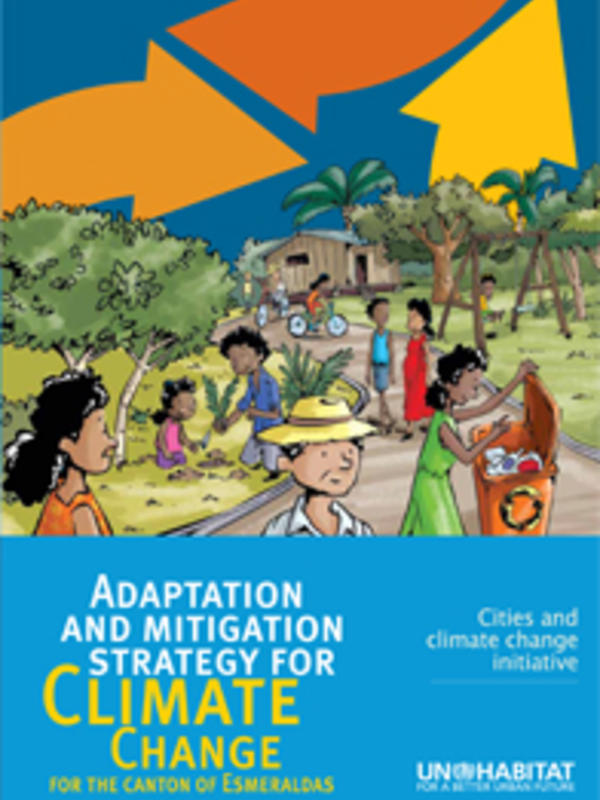
Adaptation and mitigation strategy for climate change for the canton of Esmeraldas

This is an orienting document seeking to provide technical guidelines that will facilitate the design and implementation of policies and actions aiming at fighting the adverse impacts of climate change. It was drawn up in a participative fashion and was based on the empowering documents for the management of development in canton Esmeraldas in Ecuador. It is made up of two strategic objectives and three core themes. A series of Action Lines of each one of the areas identified as priority by the local population are proposed for each one of these components.

View online/download
External Link

Urban patterns for a green economy: working with nature

Part of a series of four, entitled Urban Patterns for a Green Economy, this guide (Working with Nature) focuses on the effect of unplanned, rapid growth of cities on the functioning of a city-region’s natural systems. It outlines how guided development can maximise the ability of ecosystems to support sustainable human and natural processes. It offers a perspective on how to work with nature and the ecological processes in regions, and looks at the need to work across scales; to understand regional systems; and develop principles and measures that can be applied at the regional, city and local scales.

View online/download
External Link

Urban patterns for a green economy: leveraging density

Part of a series of four entitled Urban Patterns for a Green Economy, this guide explores the compact city and its benefits within the developed and developing world’s contexts. The guide illustrates how the compact city concept and planned (versus unplanned) urban extension can support sustainable urban patterns that benefit the functioning of developed as well as developing world cities. Properly managed, compaction can positively enhance the life of the city dweller and support related strategies aimed at promoting a green economy and sustainable urban settlements.

View online/download
External Link

Urban patterns for a green economy: clustering for competitiveness

Part of a series of four entitled Urban Patterns for a Green Economy, this guide argues that strategic investment in physical infrastructure with the diversification of economies allows cities to play a specialized role in polycentric urban development. Furthermore, it suggests that green economic development can be achieved through the development of green clusters and green jobs. Finally, this guide argues that a number of green economy outcomes may be reached through efficiencies and shared infrastructure, rather than duplication.

View online/download
External Link


Suggest a publication

Feel free to submit a publication.

Submit here