Languages

Topbar Menu EN

The SDG Fund is operationally closed. This site is alive for knowledge and dissemination purposes.
Warning: This website is closed. Be aware of phishing or social engineering fraudulent requests of payments or certificates. Explore our programme areas.
Please visit jointsdgfund.org
Search our database of publications


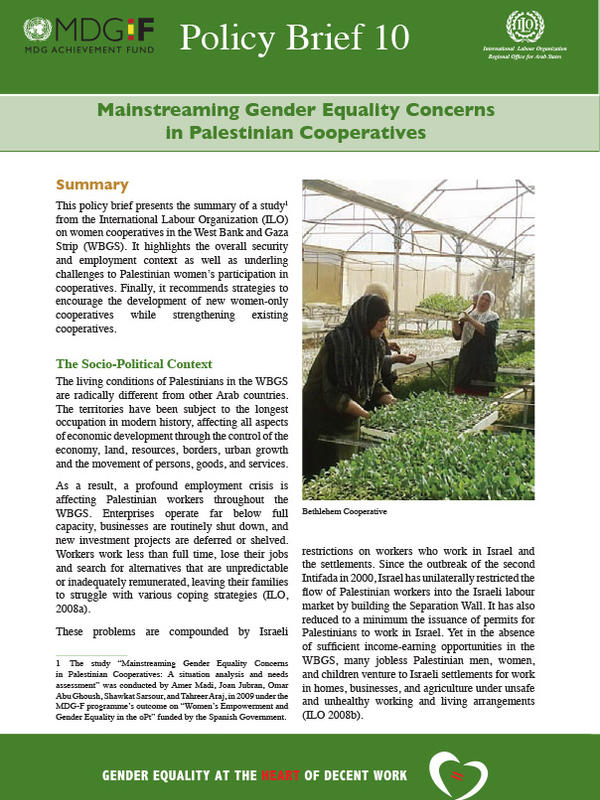
Mainstreaming gender equality concerns in Palestinian cooperatives

This policy brief presents the summary of a study from the International Labour Organization (ILO) on women cooperatives in the West Bank and Gaza Strip (WBGS). It highlights the overall security and employment context as well as underlying challenges to Palestinian women’s participation in cooperatives. Finally, it recommends strategies to encourage the development of new women-only cooperatives while strengthening existing cooperatives.

View online/download
English

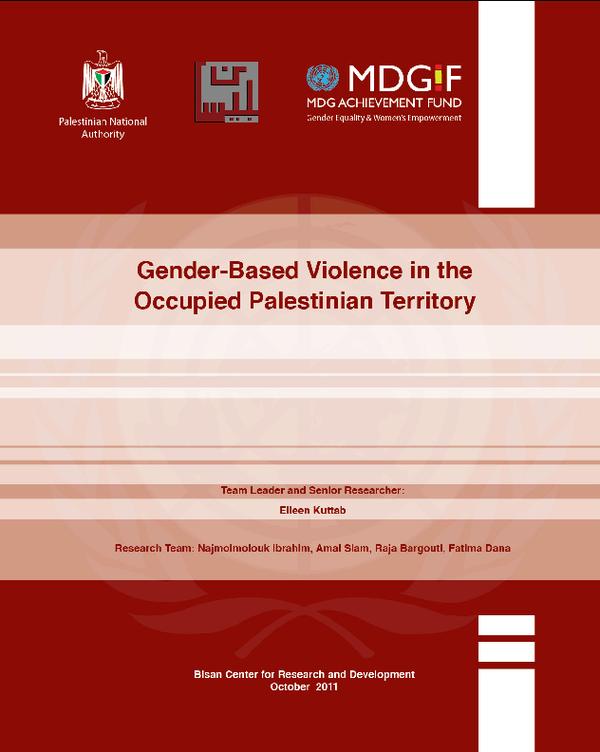
Gender-based violence in the occupied Palestinian territory

One of the gender impacts of the Israeli/Palestinian conflict is the wider prevalence of gender-based violence (GBV) as a phenomenon in the occupied Palestinian territory (oPt), which is expressed in different forms and structurally entrenched to become a way of life. This report exposes different forms of violence as revealed in women’s own narratives. It explores the conditions of their abuse as well as the coping strategies they use in their efforts to maintain their families’ well being, but which also compromises them due to the absence of realistic alternative options. It concludes with a list of findings and recommendations on how to strengthen the commitment to combat violence against women in the oPt.

View online/download
English

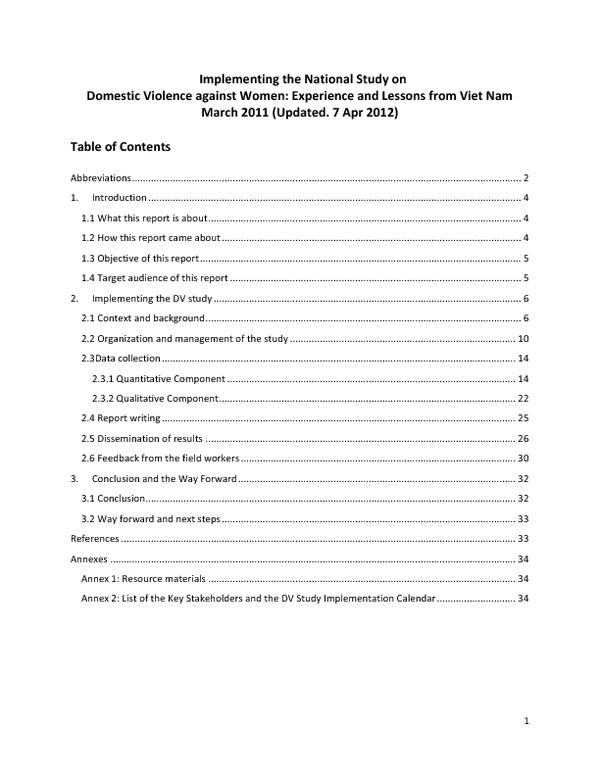
Implementing the national study on domestic violence against women: experience and lessons from Viet Nam

This report documents key steps, stakeholders and lessons learned from conducting a large-scale survey designed to document the evidence of domestic violence in Vietnam. The study produced rich data on the issue of violence against women in Vietnam, however, further analysis of the raw data is needed to draw out more information and knowledge from this study. This document is primarily intended for field workers involved in the gathering of data and conducting household surveys, General Statistical Office (GSO) officials, UN officials who work with the Government of Vietnam as well as any organizations working on domestic violence prevention.

View online/download
English

Improving the efficiency of the Ethiopian edible oil value chain

Ethiopia’s oil seeds commodity production and edible oil processing industry remain, to a large extent, underdeveloped and cheap, imported palm oil has put the local edible oil industry under additional pressure. This document outlines the basic goals and challenges behind a joint programme that aims to serve as a model on how to transform the small scale edible oil processors from being marginalized to becoming competitive and supplying the market with high quality edible oil.

View online/download
English

Small-scale edible oil milling operations: alternative business models for Ethiopia

The Ethiopian government is aiming to achieve self-sufficiency in edible oil by 2015. The government is planning to ban the sale of crude oil and, compounded by input and technological challenges, this means that the future of the small-scale millers and the supply of two thirds of domestic production have become uncertain. This research study presents an analysis of the opportunities open to and the challenges faced by small-scale millers in Ethiopia, with a special emphasis on noug seed millers, as well as portrays alternative business models that will improve the competitiveness of small-scale millers and increase food safety and security.

View online/download
English

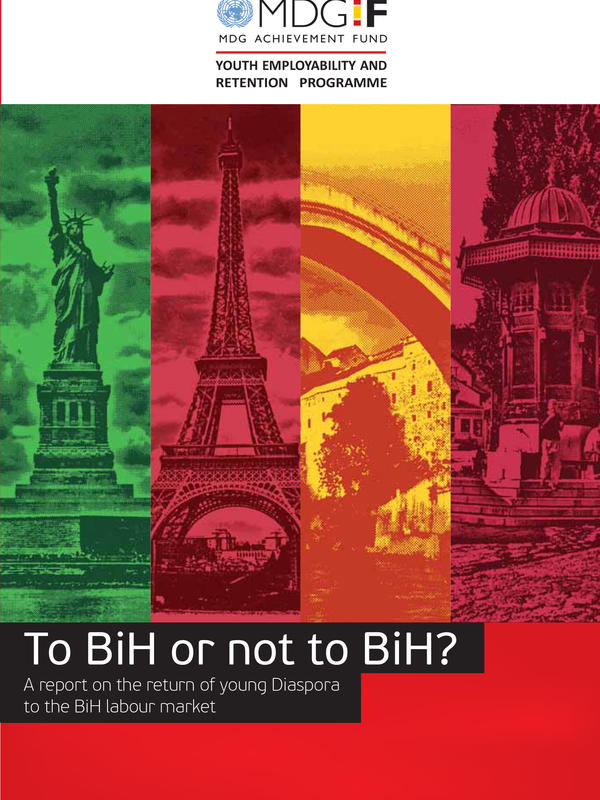
A report on the return of young diaspora to the BiH labour market

This was a first mapping of the potential for the return of migrants, re-integration into the labour market, and contribution to the development of Bosnia and Herzegovina (BiH) by its young Diaspora. The results of the survey, including demographic characteristics of the migrants; motivations for and obstacles to their return and reintegration into the BiH labour market; ties to and identification with their home country; as well as comparisons across groups, are analysed in their report. The aim is to identify the challenges and opportunities for young Diaspora to return successfully to BiH as well as to identify interest and motivation to contribute to its development whether or not they are interested in returning. It offers policy considerations as well as suggestions for future researchers in BiH.

View online/download
English

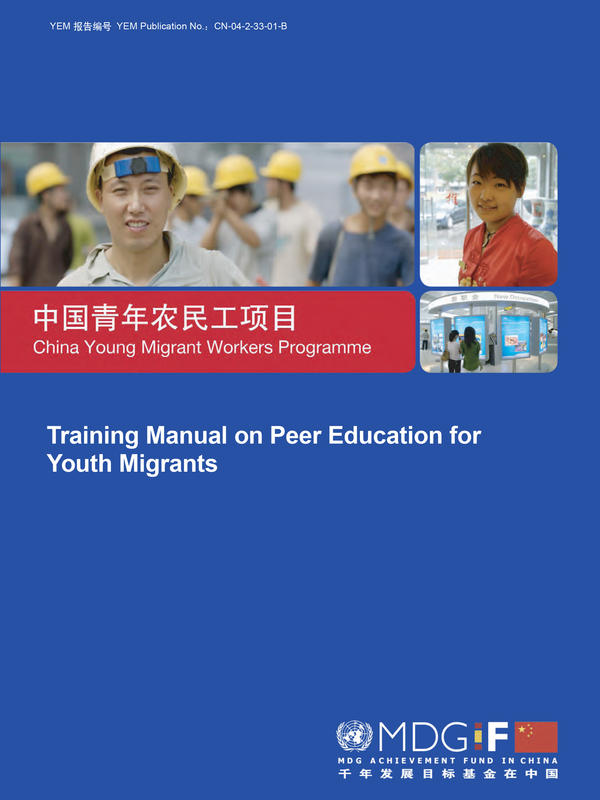
Training manual on peer education for youth migrants

This manual was part of a three year joint initiative of the UN and the Chinese Government called, “Protecting and Promoting the Rights of China’s Vulnerable Migrants. Its objectives were to support the Chinese Government to promote the protection of the rights and interests of internal migrant workers. The manual was developed based on the rich experiences in peer education that UNFPA gained through implementing migrant youth intervention projects in China. Being young and mobile, and exposed to opportunities and challenges in a new environment, migrant youth are easily influenced by their peers. Peer education makes use of this peer influence to promote positive changes on behaviors among them. This manual is a training tool to guide the development and implementation of health promotion programs targeting migrant youth. It is designed in order to conduct systematic training for program staff before launching peer education intervention projects.

View online/download
English

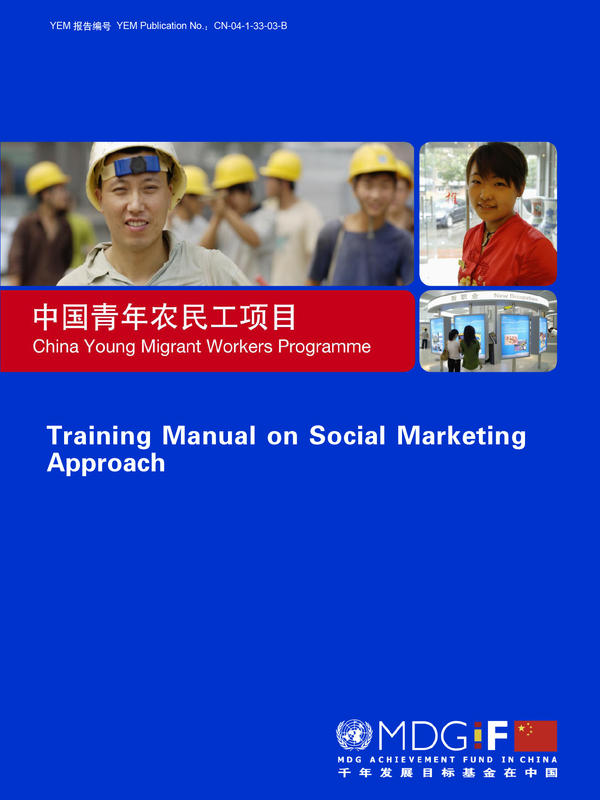
Training manual on social marketing approach

This manual was part of a three year joint initiative of the UN and the Chinese government called, “Protecting and promoting the rights of China’s vulnerable migrants". Its objectives were to support the Chinese government to promote the protection of the rights and interests of internal migrant workers. The manual is part of an effort to use social marketing as a way to increase young migrants’ health knowledge and risks awareness, as well as to improve their access to and utilization of health services. It can be used to organize systematic training for staff of government and NGOs on social marketing interventions. Users will be able to differentiate social marketing from commercial marketing and gain insight into the importance of an audience-centered approach, e.g., the need to help targets analyze the costs and benefits of a behavior as opposed to telling them right from wrong. Project management skills will be developed and the ability to conduct a “Situation Analysis” is an expected outcome as well.

View online/download
English

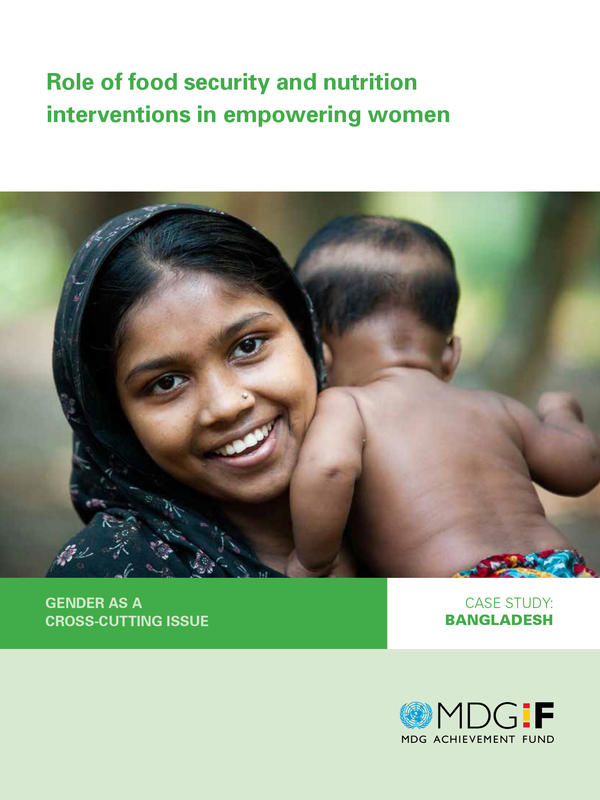
Role of food security and nutrition interventions in empowering women

In response to the high levels of food insecurity and under nutrition among women and young children in Bangladesh, the World Food Programme (WFP), Food and Agricultural organization (FAO) and United Nations Children’s Fund (UNICEF) initiated a joint programme to improve maternal and child nutrition in one of Bangladesh’s most impoverished regions. The programme, “Promoting and Protecting food Security and Nutrition for Families and children in Bangladesh” was designed to contribute towards the reduction of acute malnutrition and underweight prevalence amongst children 0-59 months and pregnant lactating women, and to reduce the proportion of the population that is food insecure. This study attempted to focus on the role of the joint interventions in enhancing women’s capabilities to increase the families’ food security and nutrition.

View online/download
English

Online sharing of water and sanitation knowledge

Sharing good practices, lessons learned and useful experiences from water and sanitation development project programs and initiatives are important to enhance efficient project development and implementation of water and sanitation projects. This report summarizes a review of how, where and to some extent what kind of so-called “best” practices and lessons learned from the water and sanitation community can be found online. It aims primarily to enhance the understanding of “what is out there” in order to align communications and dissemination strategies accordingly, but can also help programme developers and implementers to find useful information on water supply and sanitation.

View online/download
English

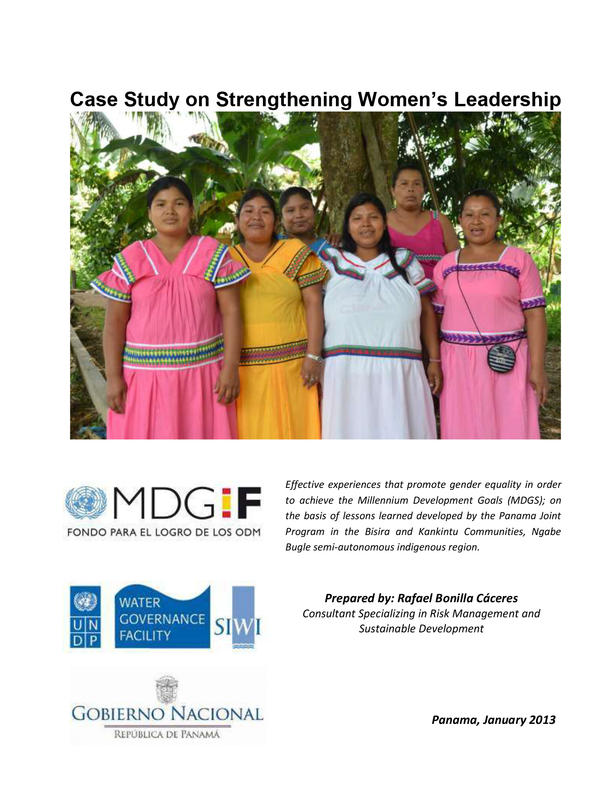
Case study on strengthening women’s leadership: Panama joint programme

This case studies is about an MDG-F Joint Programme (JP) that was aimed at reducing gaps in safe water and sanitation public services by empowering citizens in excluded rural and indigenous areas in the Bisira and Kankintu communities in Panama. It also focused on empowering women by achieving a greater balance of power in the relations between women and men and served as a tool to allow women of these communities to enjoy better living conditions and recognize their rights in a participatory society. The study contains a situational analysis of the role of women in the JP development, the historical role of ngabe women in the development of their communities, and of the participatory approach and assimilation that women and men had in the implementation of the program and how this changed their lives. It concludes with the challenges, lessons learned, best practices and suggestions for replication in order to strengthen female leadership in indigenous communities.

View online/download
English

Towards a peoples’ multilateralism: the United Nations, development networks and civil society

This paper is an attempt to review and synthesize the main literature, arguments, theories and proposals coming from academia, civil society, politicians and commentators on the “new multilateralism”– a complex, multilayered process where non-state actors have become increasingly important players in global governance. The paper goes on to look at key recent trends within civil society thinking and practice, and analyses the historical and emerging relationship between the UN and civil society. Finally it suggests principles for better engagement between the UN and civil society and funnels recommendations on which UNDP may commission further studies, start discussions or set in train processes that will create a better understanding of how to strengthen space for civil society engagement in global governance and what the role of the United Nations and of UNDP in particular can be in channeling civil society contributions to the vision of a revitalized multilateralism.

View online/download
English

Children, food security and nutrition: review of MDG-F joint programmes key findings and achievements

The Millennium Development Goals (MDGs) using a joint programme (JP) mode of intervention supported through its window on Children, Food Security and Nutrition programmes to halt preventable deaths caused by child hunger and poor nutrition. The window allocated US$134.5 million through 24 JPs in 4 regions - Africa, Asia & Pacific, Europe and Central Asia, and Latin America and Caribbean and represented almost 20% of the Fund’s work. The purpose of the JPs in the 24 countries was to improve the health, nutritional and education status of the poor and vulnerable households keeping in view the United Nations Development Assistance Framework (UNDAF) outcomes. This report consolidates the design and progress to capture the main achievements in the 24 JPs through a literature review.

View online/download
English

Conflict prevention and peace building: review of MDG-F joint programmes key findings and achievements

The Millennium Development Goals (MDGs) using a joint programme (JP) mode of intervention sponsored 20 programmes, on conflict prevention and peace building, with an allocation of US$ 94 million. This report focused on the Window on Conflict Prevention and Peace Building. The programmes in this window sought to contribute to the achievement of the goals through interventions tackling conflict prevention and violence reduction, livelihood improvements against youth violence, and the fostering of dialogue and equity. One common premise was ensuring that people knew and exerted their rights as an important component of a peace building and conflict prevention strategy. A key feature of this window was that the results were very country/region and context specific (as in the good examples of Mexico, Serbia and Colombia, for example). What the ‘successes’ share is a focus on community needs and specific needs in a specific setting that make it challenging to be replicated in other contexts; as the analysis in the report shows, there are some commonalities by theme.

View online/download
English

Recommendations for the application of an intercultural approach in rural water and sanitation projects

The present document is one of the results of the joint research initiative “Transcultural Transparency” by the MDG-F and SIWI focusing on how to overcome socio-cultural clashes between communities, service providers, development cooperation actors and local authorities, particularly in indigenous areas. It poses recommendations to be borne in mind by the different stakeholders when working on water and sanitation with indigenous peoples in Latin America. The recommendations made in this document are applicable to any intervention for water and sanitation in rural areas, but with special emphasis on the cultural contexts indigenous and ethnic minorities in relation to which the socio-cultural differences matter greatly for the definition and implementation of successful projects.

View online/download
English

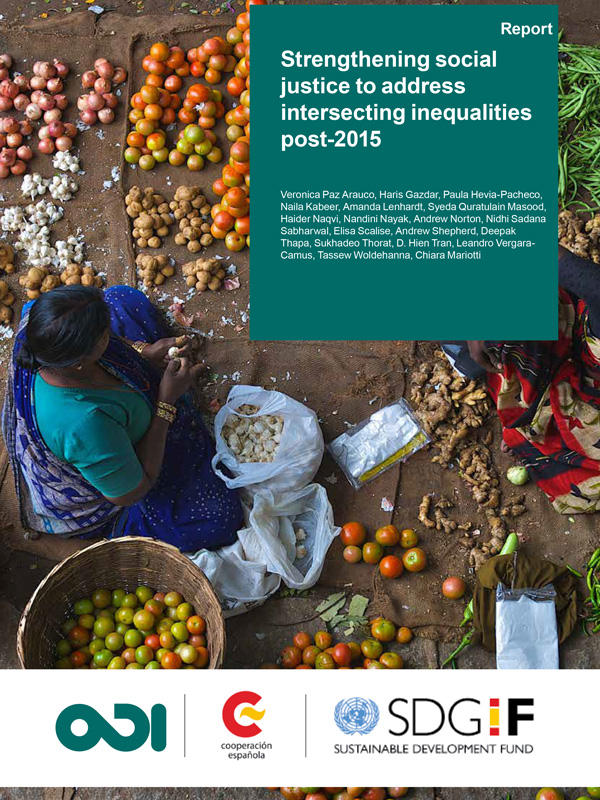
Strengthening social justice to address intersecting inequalities

The people most likely to be left behind by development are those facing ‘intersecting inequalities’, or economic deficits intersecting with discrimination and exclusion on the grounds of identity and locational disadvantage. The experience of seven countries (Brazil, Ecuador, Bolivia, India, Ethiopia, Pakistan and Nepal) shows that key ingredients for addressing intersecting inequalities are: social movements demanding changes in the ‘rules of the game’; political trajectories and processes of constitutional change that facilitate and actualize these changes; social guarantees, opportunity enhancements and developmental affirmative actions as well as specific policies and programmes which show commitment to reduce intersecting inequalities over time. The post-2015 agenda can help establish global norms which will support and encourage mobilisation to tackle intersecting inequalities, including a strong commitment to universal quality basic services, and the development of countryspecific frameworks of targets and indicators monitoring intersecting inequalities.

View online/download
English


Suggest a publication

Feel free to submit a publication.

Submit here